The Charles H. Boustead Tunnel transports water from the Fryingpan River via gravity to the Turquoise Lake Reservoir.


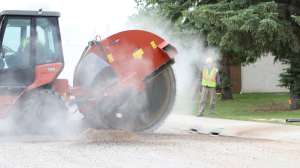
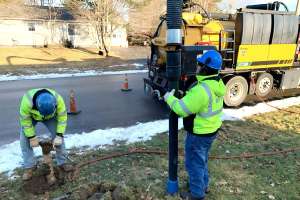
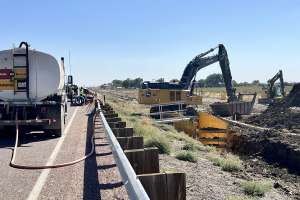
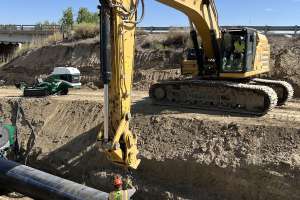
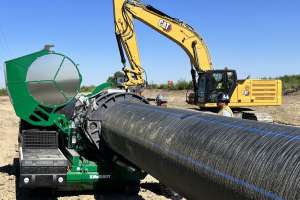
Construction of the first segment of pipeline began in November 2024.


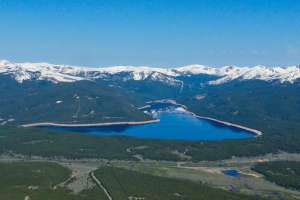
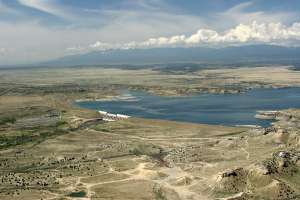
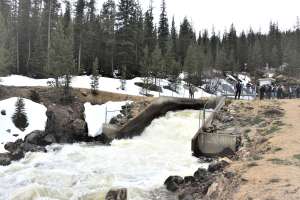
The Charles H. Boustead Tunnel transports water from the Fryingpan River via gravity to the Turquoise Lake Reservoir.
Construction of the first segment of pipeline began in November 2024.
After a delay of more than 60 years, work is finally underway on a $1.4 billion pipeline project that will provide residents in southeastern Colorado’s Arkansas Valley with something many of them haven’t enjoyed in decades: a reliable source of quality drinking water.
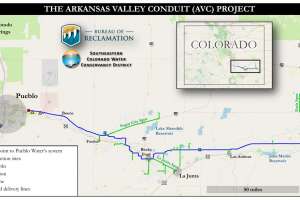
Known as the Arkansas Valley Conduit, the 130-mile-long pipeline will stretch from Pueblo to Lamar, roughly following the route of U.S. Highway 50 and the Arkansas River. It will transport water that originates in the Fryingpan River basin on the western slope of the Continental Divide to 39 small communities southeast of Pueblo with a combined population of about 39,000 residents, says Chris Woodka, senior policy and issues manager at the Southeastern Colorado Water Conservancy District.
Construction crews broke ground for the pipeline in early 2023. It will bring an average of 7,600 acre- feet of water per year to the water-starved communities, but could carry a maximum of 11,000 acre-feet and accommodate population growth up to 50,000 people in those communities.
“The pipeline will string together many inefficient water systems with one very efficient delivery line,” says Woodka.
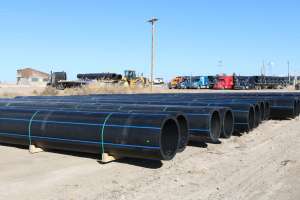
Made from either PVC and HDPE pipe, the pipeline will start out with 30-inch-diameter pipe, then reduce to 24 inches in diameter and eventually decrease to 16 inches, Woodka says.
The SECWCD is quarterbacking the pipeline project in part because the state legislation created the utility in 1958 to advocate for it. In partnership with the U.S. Bureau of Reclamation , the agency maintains four reservoirs and dams — one reservoir and dam on the western side of the Divide and three of each on the eastern side — plus a so-called transmountain diversion tunnel that carries water by gravity under the Divide. The water eventually moves through two reservoirs before it flows into the Arkansas River and then into a reservoir outside of Pueblo, he says.
“Our job is to allocate and sell water by the acre foot to municipal and agricultural users on a wholesale basis,” he explains.
Funded largely by property taxes in nine counties, the utility currently serves 24 municipalities, 34 small water companies formed by pockets of residents in remote locations, two conservancy districts and eight special taxing districts.
The communities badly need a reliable source of quality water. Most of them rely on municipal wells, which pose two problems. If the wells are shallow, they hit an alluvial aquifer that contains contaminants such as selenium, iron and manganese. If the wells are deep, they tap into a shale formation and collect naturally occurring radionuclides that include radium, uranium and other radioactive elements.
“As a result, affected communities either can’t use the water, must filter it or install expensive treatment solutions, such as reverse osmosis, to remove the radioactive material,” Woodka says. “And even if filters are used, the cost of disposal is very expensive.
“There are all kinds of issues associated with using groundwater from deep or shallow wells here.”
In addition, springs that supply some of the underground water sources can dry up periodically. And communities that have installed reverse osmosis treatment systems have to contend with brine, a byproduct that is expensive to treat.
“The quality of water in the Arkansas River valley has always been poor,” Woodka says. “The earliest settlers called it brackish water.”
Former President John F. Kennedy was still in office when the Fryingpan-Arkansas Project Act was approved by Congress in summer 1962. The project — known locally as the “Fry-Ark” — included five dams and reservoirs, a hydroelectric power plant and 22 tunnels/conduits totaling 87 miles.
Everything but the pipeline from Pueblo to Lamar was completed by 1985.
The sticking point? Funding. The small regional communities simply couldn’t afford the $25 million price tag, Woodka says.
“Back in 1968, that cost was eye-popping for people,” he notes.
After about 10 years of no movement, the historic inflation spike during the 1970s drove up the cost even further.
“In 1978, the district threw up its hands and said it was too expensive to do it,” he explains. “And in the ensuing years, other proposed options made it even more expensive.”
By 2016, the cost had risen to $600 million.
As such, the project remained stalled. But it received a jump-start in 2021 via $250 million in funding from the Infrastructure Investment and Jobs Act approved by Congress in 2021. In addition, Colorado’s congressional delegation is helping to secure another $840 million in federal funding through annual appropriation bills.
Many communities located in Colorado’s so-called Front Range, east of the Rocky Mountains, rely on water that comes from the western side of the Divide. In fact, about 90% of the state’s population — as well as farms, ranches and industries — are located east of the mountains and rely primarily on water that starts out as snowmelt on the other side of the Divide.
To transport that water to reservoirs along the Front Range, 44 transbasin diversions, or tunnels, have been built, including 27 that cross the Divide. The water that will fill the AVC originates some 200 miles away, at the headwaters of the Fryingpan River near Leadville, and travels through one of those tunnels.
Completed in 1972, the roughly 5 1/2-mile-long, 10-foot-diameter horseshoe-shaped Charles H. Boustead Tunnel transports water from the Fryingpan River via gravity to the Turquoise Lake Reservoir. From there it eventually flows into the Arkansas River and heads down to a reservoir in Pueblo.
Before the water travels to the 39 communities, it will be treated in a plant owned by the Pueblo Board of Waterworks, then circulate through the city’s water system, comingling with the city’s water supply along the way, before entering the underground pipeline.
“Essentially, we will become a customer of the Pueblo water system,” Woodka says.
The project will include two 400,000-gallon regulating tanks about 30 miles apart.
“Because of the slope of the pipeline, which drops from around 4,700 feet of elevation at the Pueblo Reservoir to around 3,300 feet at Lamar, water travels fast and creates vibrations,” he explains. “These surge-protection regulating tanks will slow down the water.”
Water will travel from the pipeline to the individual communities via 39 delivery lines. Those communities are responsible for paying for any infrastructure required to handle the incoming water.
The project also includes construction of an injection site, which is a small treatment plant where chemicals will be added to the water to remove any trace amounts of ammonia.
As of late November 2024, about 9 miles of the first stretch of pipeline, which runs eastward from Pueblo to the community of Boone, has been completed. So have two delivery lines, one to Boone and one to Avondale, and the first injection site also is under construction.
The affected communities also have work to do. Some will need infrastructure such as water storage tanks or more or larger storage tanks. And all will have to install equipment to adjust the water’s chlorine and pH levels.
“We’ve identified what each community will need to receive and distribute water, as well as outlined another group of projects to replace existing leaking lines, install water meters and so on.
“The communities have to pay for those costs, but we’re helping them find funding sources,” Woodka says. “There are a lot of moving pieces involved.”
Along with the obvious public health benefit for residents, the pipeline also will likely revive economic development in the small communities.
“That’s one of the main reasons why communities advocated so hard for this project,” Woodka says. “There are a lot of chambers of commerce and city councils in the valley that are looking ahead and saying this will help their economic development.”
Woodka has a deep personal interest in the AVC project. During the last 40 years, he’s watched it both stall interminably and slowly start to progress, both as a local newspaper reporter covering regional water-related issues and as an employee of the SECWCD. As a result, he’s deeply gratified to see it finally taking shape.
“I look at this project as a generational mission,” he says. “A lot of people living here now may not even see the benefits, but their children and grandchildren certainly will — and that’s the overriding vision we’ve had all along.
“I’ve watched this project for more than 40 years, both personally as a journalist and while working on the project. And it feels really good to do something that will help meet not only immediate needs once it’s completed, but continue to meet future needs for decades afterward.”
Continue reading for free