As a massive, 30-year-long, $4 billion sewer-rehabilitation program continues to move along in Kansas City, Missouri, green stormwater infrastructure has emerged as a major tool in the city’s efforts to rein in combined sewer overflows as mandated by a federal consent decree.
In 2010, the city reached an agreement with the United States Environmental Protection Agency to reduce CSOs by capturing more than 85% of CSOs that occur in a typical year. Since then, 18 green infrastructure projects have been installed at a cost of more than $91 million, says Andy Shively, deputy director of wastewater and stormwater engineering at KC Water, which operates the city’s water and sewer systems.
The green infrastructure projects cover about 31 acres of land that manage stormwater draining from approximately 326 “green acres.” A green acre is one acre of an impervious surface — everything from rooftops to parking lots to streets — that drains into a green infrastructure site, he says.
In total, those 31 sites provide 7,674,000 gallons of stormwater storage capacity.
An additional seven green infrastructure sites are currently being installed, with $28.5 million budgeted in fiscal year 2025. And when the mammoth initiative, called the KC Smart Sewer program, is completed in 2040, the utility will have installed approximately 35 green infrastructure sites that will capture stormwater from around 750 green acres. The total estimated cost for all the green infrastructure installations is around $400 million.
“We were the first federal consent-decree participant to include green infrastructure,” Shively says, noting that Kansas City now is considered a national leader in using this stormwater management strategy. “We’ll be installing green infrastructure for the next eight to 10 years.”

Strategy shift
The reliance on green infrastructure in the Smart Sewer program marked a major shift in the utility’s philosophy regarding stormwater collection. Instead of an old-school emphasis on larger and larger “gray” infrastructure that collects and transports as much stormwater as possible, the utility instead pivoted and decided to focus on green infrastructure that soaks up as much rainfall as possible, thus preventing it from reaching combined sewers and overwhelming the system, Shively says.
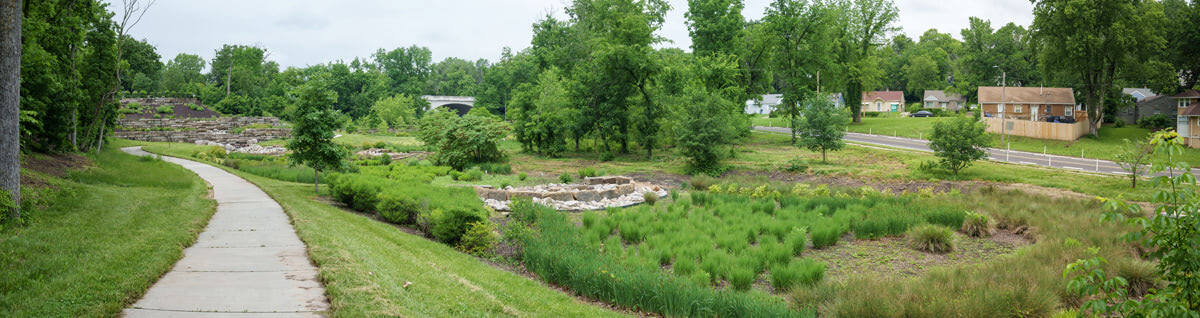
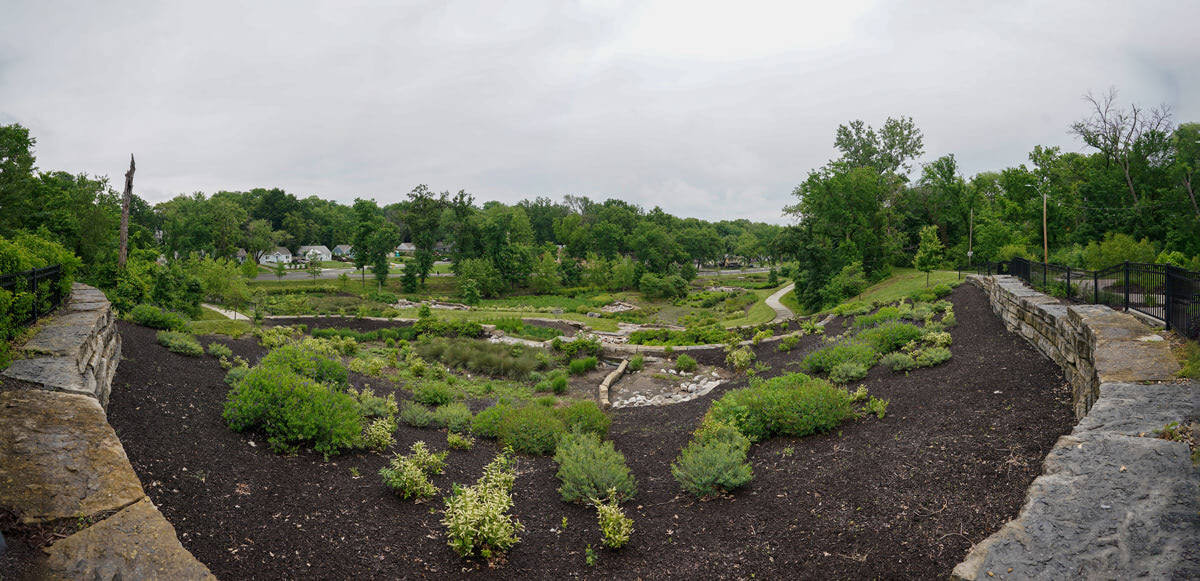
Types of green infrastructure include bioretention and detention basins, bioswales, rain gardens, permeable pavers, green roofs and infiltration trenches. Aside from the benefit of reducing the amount of stormwater entering the city’s 1,060 miles of combined sewer systems — all clustered within 58 square miles of the city’s urban core — green infrastructure can be less expensive than installing new sewer lines and much less disruptive, he says.
In fact, stormwater management experts note that it’s becoming more and more difficult to justify the high cost of digging up city streets and installing larger-diameter pipes that, except during isolated extreme rainfalls, use only a fraction of their capacity on a daily basis.
Furthermore, these eco-friendly installations also recharge groundwater. In addition, they also serve as a catalyst for economic development of neighborhoods and enhance residents’ quality of life by including park-related amenities such as pedestrian/biking paths, soccer and baseball fields, playgrounds, recreational areas and the like, Shively says.
Even simple projects can make a substantial difference. For example, during a typical 1.4-inch rainstorm, a one-block-long, 100-foot-wide section of a standard four-lane city street with a paved median strip in between the driving lanes generates nearly 57,600 gallons of stormwater runoff, according to the KC Water website.
But installing vegetation in the median can reduce that runoff to about 50,799 gallons — a 12.5% reduction. And adding green infrastructure along sidewalks reduces it even further to less than 41,500 gallons — a decrease of nearly 32.5%.

Outside the sewer
A good example of green infrastructure is located in the historic West Bottoms neighborhood in the city’s central industrial district. This project combined conventional gray infrastructure solutions with cost-effective and eco-friendly green infrastructure.
Completed in 2020, this $8.6 million project — which won a national award for best environmental project from the American Public Works Association in 2021 — is designed to absorb about a million gallons of stormwater.
The project features a roughly 5-acre bioswale landscaped with native plants, shrubs and trees; stormwater tree planters; bioretention basins; two underground cisterns (18,050 gallons total capacity) that capture and temporarily store stormwater that drains from an I-70 overpass; a dry-well infiltration system; and a plaza made from permeable paving bricks laid on a deep course of gravel that stores excess rainwater until it slowly drains into the ground or escapes via underground pipes, Shively says.
In addition, the project helped create new public spaces, including pedestrian walkways and a covered outdoor space for festivals and other events. Another popular component is a boardwalk through the swale and enhanced pedestrian and bike paths and rest areas. By making the formerly run-down area more attractive, city officials hope to spur more development in the area.
“We try to layer benefits onto sewer projects instead of just putting new pipe in the ground and walking away,” Shively notes.
Public engagement is critical to successfully implementing green infrastructure projects as well as collaboration and communication with other city departments, he adds.
“I like to call it integrated public infrastructure. We work closely with the public works, parks and housing departments and neighborhood groups, for instance, to see what amenities residents want or what other work can be done at the same time — things like street, curb and sidewalk repairs — to reduce costs and disruption and provide more benefits for the community.”
Multi-faceted program
Green infrastructure isn’t the only stormwater-retention weapon in the utility’s arsenal. The Smart Sewer program consists of nearly 100 different projects of all sizes that embrace a variety of tactics and methods to reduce CSOs. They range from traditional gray capacity, storage and treatment improvements to pipe-lining and manhole-rehab work to separating a portion of combined sewers.
So far, the utility has spent about $1.2 billion on various projects. That includes the rehabilitation of approximately 100 miles of neighborhood combined sewers at a cost of about $12 million; this primarily involved lining pipes 12 inches in diameter or smaller, Shively says.
In addition, around $185 million has been invested in stopping infiltration and inflow in separated sewers. That work mostly centered on pipe lining and rehabbing thousands of manholes. The utility also invested another $82 million to separate six square miles of combined sewers.
By 2035, the utility estimates it will have invested approximately $2.3 billion in various CSO reduction projects.
“It’s the largest infrastructure improvement project in Kansas City history in terms of the overall investment,” Shively says.

Moving the needle
So far, the investments are bearing fruit. Prior to 2010, the city was capturing and treating only about half of the 12 billion gallons of sewer flow in a typical year. As such, roughly 6.4 billion gallons were discharged via approximately 90 outfalls into local creeks and streams that eventually flow into the Missouri River, the city’s primary water source.
But now, about 3.7 billion gallons — or 32% of the total flow in a typical year — are discharged. That’s nearly a 42% decrease in discharged flow.
“So we’re capturing an additional 2.71 billion gallons a year since 2010,” Shively explains. “Our goals are to capture 74% by 2030 and 77% by 2035.
“Our strategy is focused on fixing what we have first and building as little new infrastructure as possible. We’ve also set interim milestones to prove we’re moving the needle on CSO capture.”
The Smart Sewer program also calls for the construction of three deep tunnels (lengths and diameters undetermined at this point) that will store flow from CSOs until the city’s six wastewater treatment plants have the capacity to treat it. But with sewer rehab work further upstream in the area’s watersheds plus other capacity improvements, there’s a chance all of the tunnels will not be needed, Shively says.
“My goal is to get it down to one tunnel,” he says. “I would love to see no tunnels at all, but that’s probably not realistic.”
Significant benefits
While the Smart Sewer program is aimed at significantly reducing CSOs and better equipping the city to handle extreme rainfalls (two- and five- year, 24-hour rainstorms), it also will improve water quality in area waterways, boost the city’s resiliency in the face of climate change, protect public health and support sustainable urban development. And modernizing the city’s sewer infrastructure reduces the risk of system failures, sewer backups in buildings and emergency repairs and also ensures long-term reliability, Shively says.
At the same time, the program will boost local economies and enhance neighborhood livability.
“In essence, the Smart Sewer Program is not just a fix — it’s a futureproofing strategy that will help Kansas City thrive environmentally, economically and socially for generations,” Shively says.
“Generations before us kicked the can down the road. But I’m proud that we’re the generation that’s doing something, not kicking the can farther down the road.”
Continue reading for free